
Rebilling in Procurement
April 10, 2026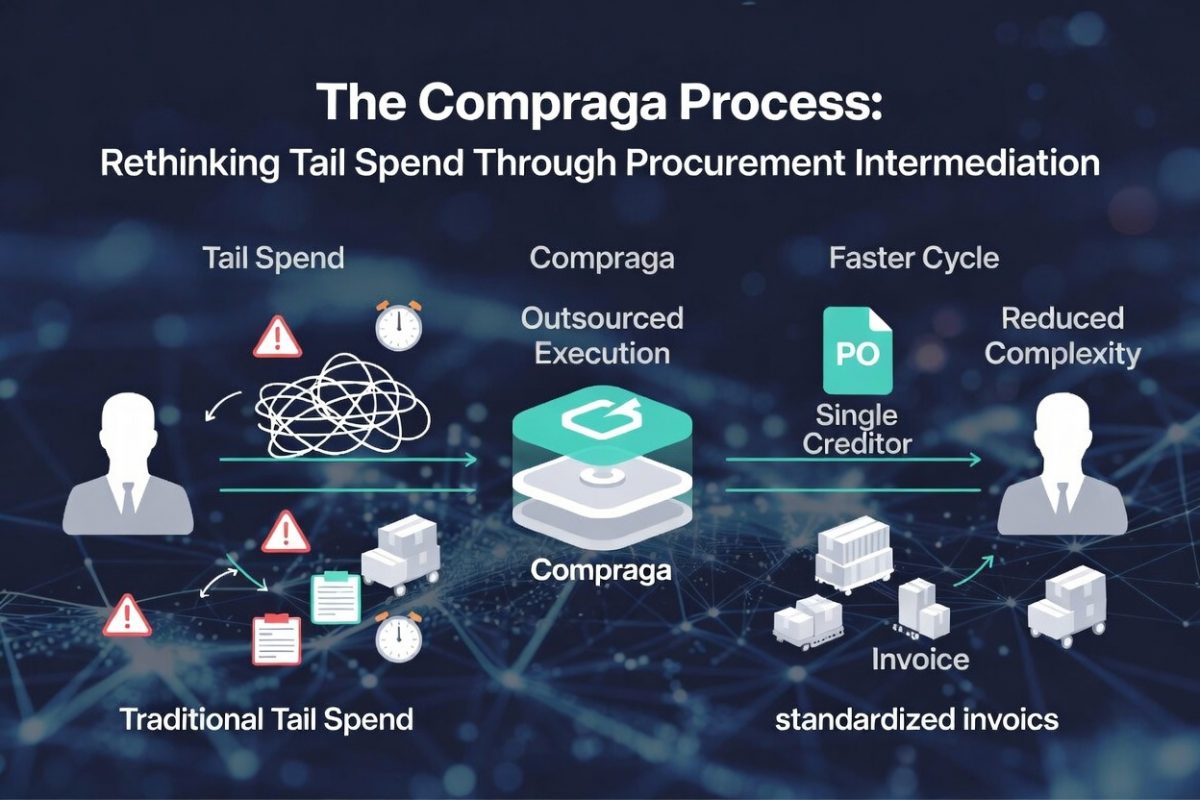
Rethinking Tail Spend Through Procurement Intermediation
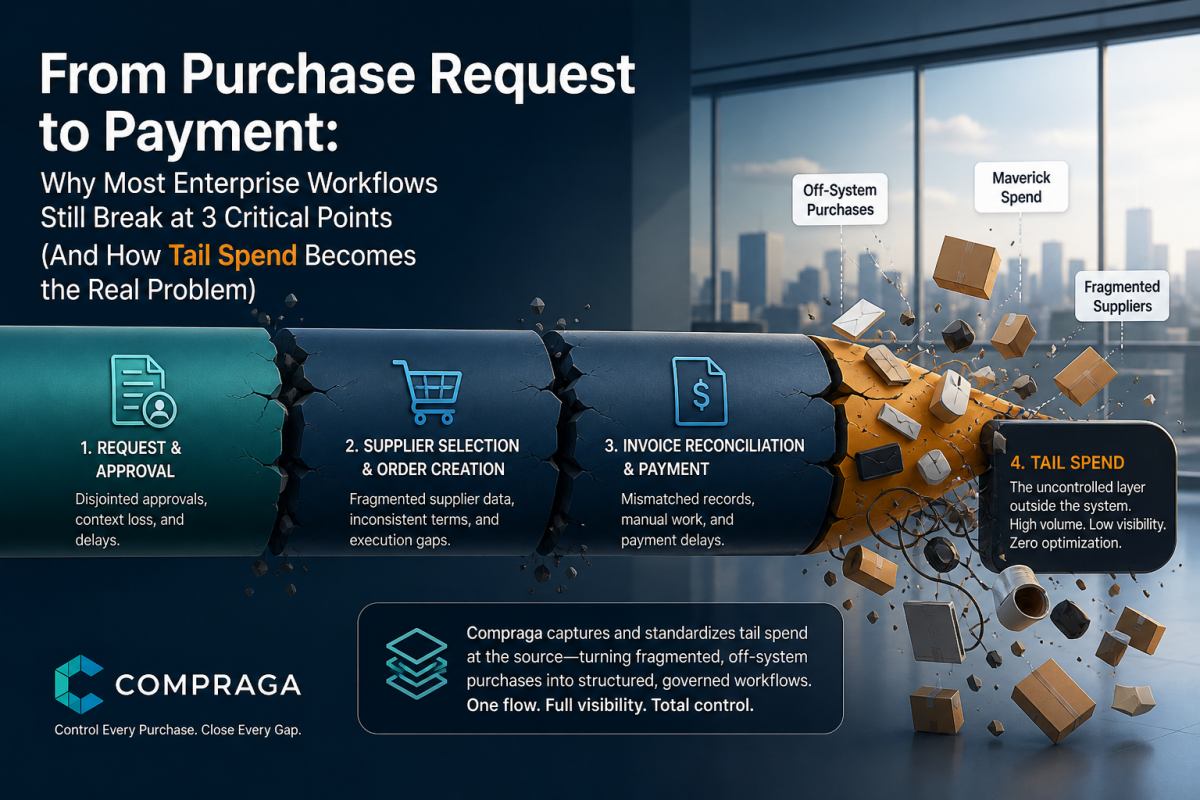
Most procurement systems are built for control, not for reality. They are designed around structured suppliers, predictable volumes, and standardized processes. As long as purchasing follows these rules, the system works. The problem begins where these rules no longer apply. Tail spend sits exactly in that gap. It is fragmented, urgent, and often incompatible with internal procurement structures. This is where the Compraga process positions itself, not as an extension of procurement, but as an operational layer that absorbs its inefficiencies.
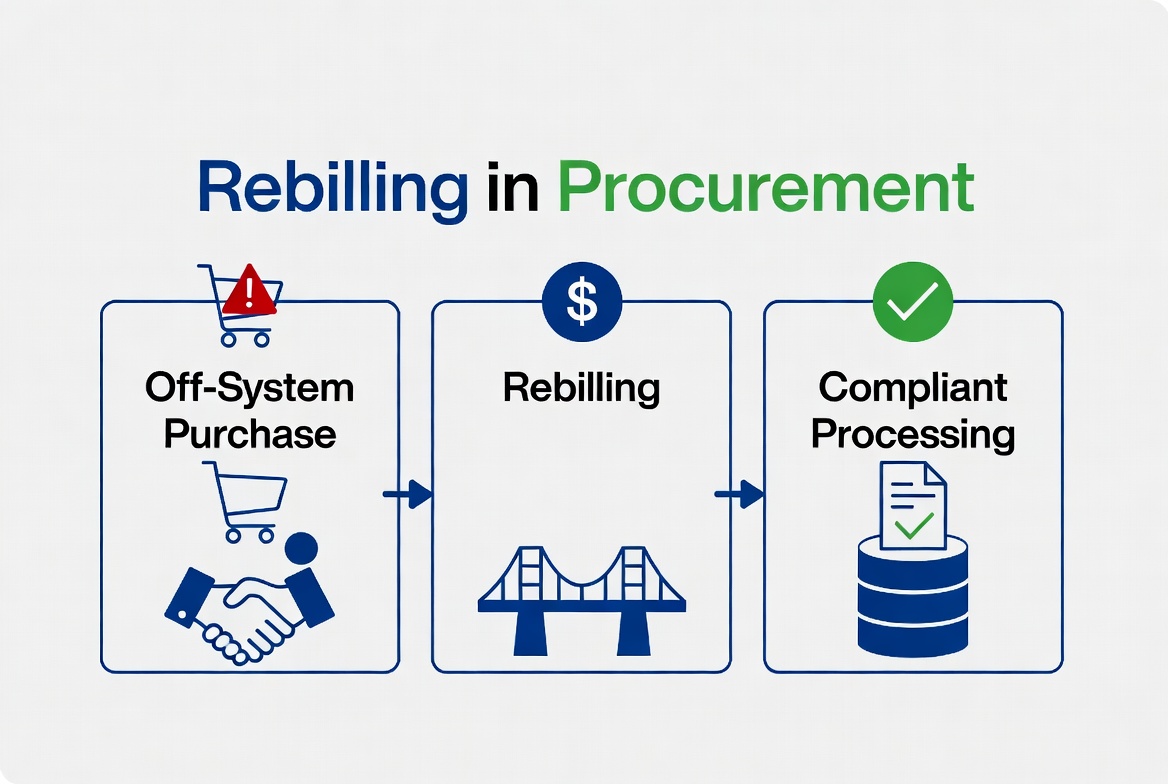
At its core, the Compraga model is a form of Business Process Outsourcing focused specifically on tail spend. Instead of forcing irregular purchases through rigid internal systems, companies shift execution to an external intermediary. The mechanics are straightforward. The company issues a purchase order, not to the supplier, but to Compraga. From that point onward, the entire transaction is handled externally. Compraga places the order with the supplier, manages communication, verifies the invoice, and ultimately invoices the client through a single, standardized creditor relationship.
This seemingly simple shift has structural implications. The most immediate change is the reduction of supplier complexity within the client organization. Instead of onboarding and managing a large number of low-volume or one-off vendors, the company interacts with a single entity. This eliminates the need for supplier creation in internal systems, which is often one of the most time-consuming and compliance-heavy steps in procurement. The administrative burden associated with due diligence, data maintenance, and vendor management is effectively outsourced.
The impact on processing speed is equally significant. Traditional procurement workflows are designed to enforce control, which often means multiple approval layers, system entries, and validation steps. For standard purchases, this is efficient. For tail spend, it becomes a bottleneck. By shifting execution to Compraga, purchase orders can be acted upon immediately. The intermediary operates outside the constraints of internal systems while still delivering a compliant outcome. The result is a faster procurement cycle without requiring structural changes within the organization.
From a financial perspective, the process introduces both efficiencies and trade-offs. On one side, process costs are reduced. Internal teams spend less time on low-value transactions, invoice processing is simplified through a single creditor model, and error rates decrease due to standardized handling. On the other side, the intermediary captures a margin for providing this service. The net effect depends on the balance between saved internal cost and the external fee. In most cases, the efficiency gains outweigh the additional margin, particularly in environments with high administrative overhead.
Control, which is often cited as a concern in outsourced models, does not disappear but shifts in form. Instead of controlling each individual transaction, the company controls the framework within which transactions occur. Visibility is maintained through centralized invoicing and reporting, while execution is delegated. This allows procurement teams to focus on strategic activities rather than operational tasks. The effectiveness of this shift depends on the quality of data and reporting provided by the intermediary. Without transparency, control is only perceived, not real.
Risk management is another dimension where the Compraga process alters the landscape. By acting as the contractual counterparty, the intermediary assumes part of the operational and compliance burden. Supplier verification, invoice validation, and documentation are handled externally, reducing the risk of errors within the client organization. However, this does not eliminate risk; it redistributes it. The company becomes dependent on the intermediary’s processes and standards. If these are robust, overall risk decreases. If not, issues may be harder to detect because they occur outside the internal system.
The probability of achieving efficiency gains through this model is relatively high, typically in the range of 65 to 75 percent when applied to genuine tail spend. The reason is structural alignment. The model is designed specifically for the type of transactions that traditional procurement struggles to handle. However, the probability drops if the model is extended beyond its intended scope. Using an intermediary for strategic or high-volume categories introduces unnecessary cost and reduces direct supplier engagement, which can weaken negotiating power and long-term relationships.
The dynamics become more complex when external conditions change. In a stable environment, the Compraga process functions as a buffer, absorbing operational complexity and smoothing procurement workflows. Under pressure, such as in a cost-cutting cycle, the additional margin introduced by the intermediary comes under scrutiny. Companies may attempt to internalize procurement to reduce direct costs. This can reduce the perceived benefit of the model, lowering its adoption probability by 15 to 20 percentage points. However, this often ignores the hidden costs that re-emerge when internal teams are forced to handle tail spend again.
A more critical scenario arises if the intermediary faces operational or financial constraints. Because the model relies on a single creditor relationship, any disruption at that point affects the entire flow of transactions. The dependency risk is real. If the intermediary cannot process orders, manage suppliers, or maintain liquidity, the client’s procurement operations are directly impacted. This increases the importance of due diligence and ongoing monitoring. The probability of such disruptions is relatively low in stable conditions, around 10 to 15 percent, but it increases in stressed environments, particularly if the intermediary is scaling rapidly or operating with tight margins.
There is also a strategic dimension to consider. By centralizing tail spend through a single channel, companies gain visibility that was previously unavailable. Data on purchasing patterns, supplier usage, and cost distribution becomes easier to analyze. This creates opportunities for further optimization, such as supplier consolidation or category management. In this sense, the Compraga process is not just an operational solution, but a potential entry point into more structured procurement strategies. The extent to which this potential is realized depends on how actively the company uses the data generated by the process.
Ultimately, the Compraga process addresses a specific structural weakness in procurement systems. It does not attempt to replace existing frameworks, but to complement them where they fail. By externalizing the execution of tail spend, it reduces complexity, accelerates processes, and reallocates internal resources to higher-value activities. The trade-off is a shift in control and the introduction of dependency, both of which must be managed carefully.